UAE sites put two demands on footwear at once: protect the foot against real hazards, and do it through a summer that can sit above 45 degrees for months. The wrong shoe is not just uncomfortable, it gets left in a locker, which defeats the point. For procurement teams and safety officers, the job is to match the shoe to the hazard, confirm the certification, and choose a build that crews will actually keep on for a full shift. This guide explains the standard, the class codes, and how to pick the right shoe for conditions in the UAE.
Start with the standard: EN ISO 20345
In the UAE, protective footwear is normally specified to EN ISO 20345 or the ASTM F2413 equivalent. The single most important number is the toe cap rating. EN ISO 20345 "safety" footwear has a toe cap tested to 200 joules of impact. Footwear marked EN ISO 20346 uses a lighter 100 joule cap and is classed as "protective" rather than "safety". For general construction, fabrication and heavy industry in the UAE, the 200 joule EN ISO 20345 rating is the sensible baseline, and many main contractors require it outright.
The standard was updated to EN ISO 20345:2022, and a few changes are worth knowing. Slip resistance is now a basic requirement for every compliant shoe and is marked SR, replacing the old SRA, SRB and SRC symbols. Non-metallic puncture protection is now identified separately as PL or PS, while a steel midplate is still marked P. Two new classes, S6 and S7, cover shoes with a water-repellent membrane. You will still see 2011-era markings such as S1P, S3 and SRC on stock in the market during the changeover, so it helps to understand both.
What the class codes actually mean
The class is a shorthand for a bundle of properties. The ones you will meet most often on UAE sites are:
- SB: the basic safety shoe, 200 joule toe cap only.
- S1: SB plus a closed heel, antistatic properties, energy absorption in the heel, and a fuel-oil resistant outsole.
- S1P: S1 plus penetration resistance (a puncture-resistant midplate). Light and breathable, good for dry environments.
- S2: S1 plus water penetration and absorption resistance in the upper.
- S3: S2 plus penetration resistance and a cleated (profiled) outsole. This is the default all-round construction shoe.
On top of the class you will see additional codes that matter in the Gulf: HRO (outsole resistant to hot contact up to 300 degrees), HI and CI (heat and cold insulation), A or ESD (antistatic and static-dissipative), M (metatarsal protection) and WR (whole-shoe water resistance).
Steel toe or composite toe in UAE heat
Both pass the same 200 joule test, so the choice is about weight, conductivity and comfort. A steel cap is thinner, very robust and lower cost. A composite cap (glass fibre or similar) is lighter, does not conduct heat or cold, and is non-metallic, which suits airport, electronics and security-screened sites. In UAE summer conditions the non-conductive composite cap reduces the heat the foot picks up from the cap itself, and a breathable mesh lining helps a crew keep the shoe on through the afternoon. The same logic applies to puncture protection: a non-metallic textile midplate (marked PL or PS) is lighter and covers the full footbed, where a steel midplate (P) is extremely tough but slightly heavier and more rigid.
Match the shoe to the site
A short selection guide for common UAE conditions:
- General construction, multi-hazard: S3 with a 200 joule toe, a penetration-resistant midplate and SR slip resistance. The safe default.
- Hot surfaces, roofing, asphalt, foundry: add an HRO heat-resistant outsole.
- Electrical, electronics, fuel handling: antistatic or ESD models to control static safely.
- Wet, washdown or outdoor standing water: S3 with water resistance, and consider the new S7 membrane class.
- Weight-sensitive or long-walking crews: non-metallic cap and midplate to cut fatigue.
- Light indoor assembly or stores: S1P is enough where there is no water or heavy wet exposure.
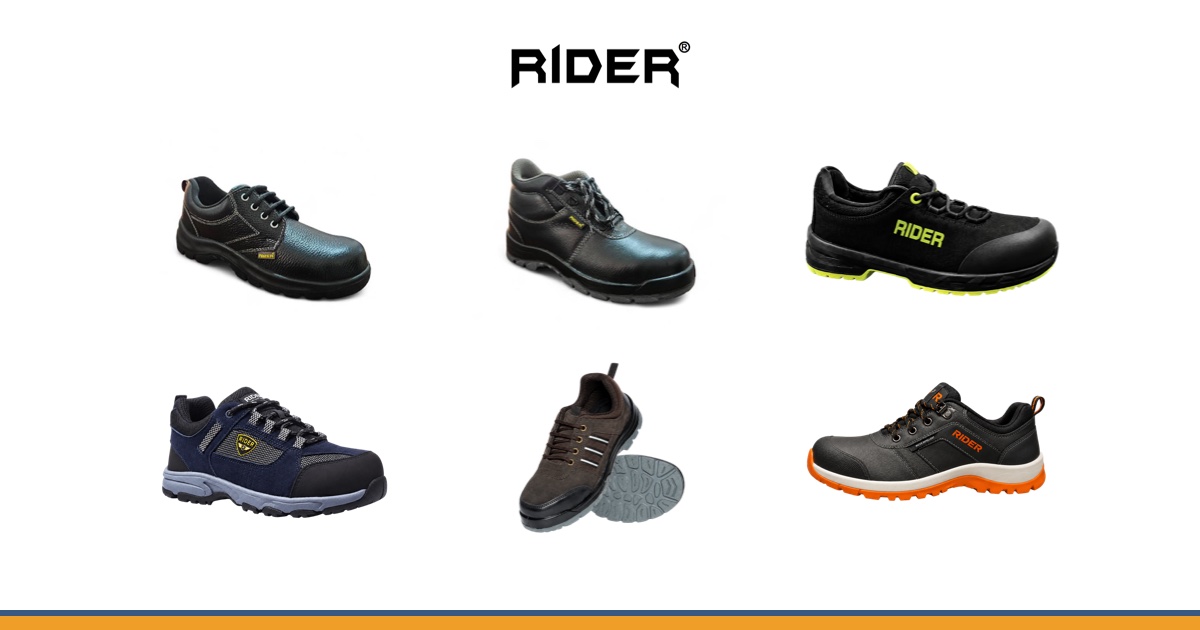
Our Rider safety shoes range is built around these conditions, with steel toe caps, 1100 N puncture protection in steel or non-metallic Kevlar, and heat-resistant soles on selected models, across nine models in EU sizes 37 to 46. Each model's specification and standards, as per the manufacturer catalogue, are on our safety shoes page.
Fit, sizing and when to replace
Certification protects the foot only if the shoe fits. Fit crews at the end of the day when feet have swelled, allow a thumb-width of toe room, and size for the socks that will actually be worn. Replace safety shoes when the outsole tread is worn smooth, the toe cap has taken a heavy impact, the upper has split, or the antistatic or heat properties can no longer be trusted. On hard UAE sites that is often sooner than a year, so build replacement into the PPE budget rather than treating it as a one-off.
Buying safety shoes in the UAE
Two practical points for procurement. Ask the supplier for the manufacturer's test documentation, because "steel toe" on a listing is not the same as a tested EN ISO 20345 cap. And buy for the site, not the price list, since the cheapest shoe that crews refuse to wear is the most expensive option you can choose. Prior Safe is an authorized Rider distributor, we carry the full range in our Ajman warehouse, and we supply at bulk and dealer pricing with delivery to every emirate within 1 to 2 working days. For head-to-toe kitting you can pair footwear with our safety PPE and workwear.
Need to match the right shoe to your site? Call or WhatsApp +971 58 582 3239, or send your sizes and quantities to ddev.chandrwanshi@priorsafellc.com, and we will come back with a same-day quote.
Frequently Asked Questions
Are S1P safety shoes enough for construction in the UAE?
For multi-hazard construction, S3 with a 200 joule toe and a penetration-resistant midplate is the recommended baseline. S1P suits lighter, dry, indoor tasks but lacks the water resistance and cleated outsole of S3.
Steel toe or composite toe for the UAE climate?
Both meet the 200 joule requirement. Composite caps are lighter and do not conduct heat, which helps in summer and on non-metallic sites, while steel caps are thinner and lower cost.
What happened to the SRC slip-resistance marking?
Under EN ISO 20345:2022, slip resistance is now a basic requirement marked SR, and the older SRA, SRB and SRC symbols have been retired. You may still see SRC on stock made to the 2011 edition.
Do safety shoes have a shelf life?
Yes in practice. Replace them when the tread is worn, the toe cap has taken a heavy hit, the upper has failed, or protective properties can no longer be relied on. Heavy UAE site use often shortens this to under a year.