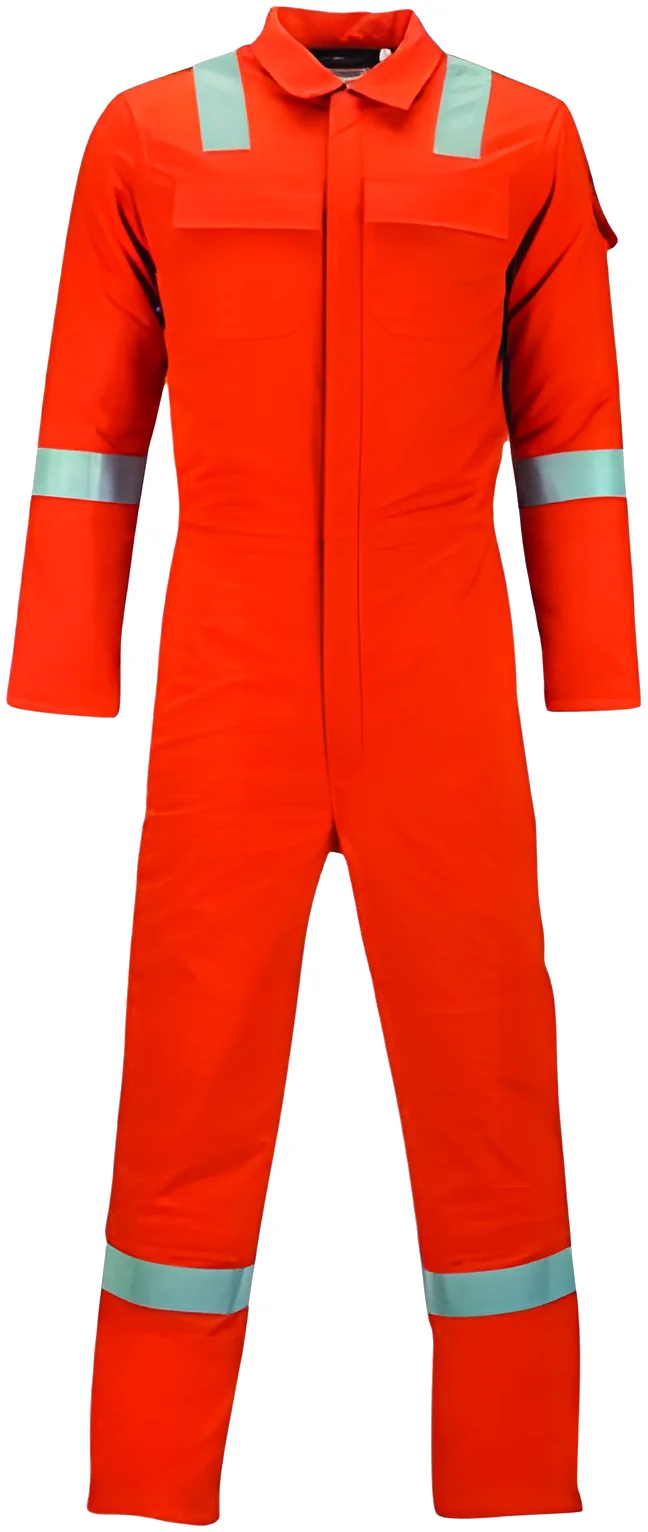
Fire retardant (FR) workwear has one purpose: if a worker is caught in a flash fire, a spark shower or a burst of heat, the garment must not ignite and keep burning, and it must not melt onto the skin. Ordinary workwear does neither reliably. Polyester melts, and plain cotton keeps burning once it catches. On oil and gas sites, in refineries, welding bays and hot work areas across the UAE, FR clothing is often the last barrier between a worker and a serious burn.
This guide explains the two kinds of FR fabric, the standards you will see on a tender or a permit to work, and how to keep FR garments protective through months of industrial washing.
Treated or inherent: the two kinds of FR fabric
Treated FR fabrics start as cotton or a cotton rich blend and are given a flame retardant finish. Pyrovatex and Proban are the two best known treatments. They are breathable, comfortable in heat and lower in cost up front. The protection depends on the treatment surviving, so washing matters: the SafeEss treated range is rated for up to 50 industrial washes. Treated fabric is usually heavier, at 240 to 280 GSM in the SafeEss range.
Inherent FR fabrics are made from fibres that resist flame by their chemistry, such as modacrylic and aramid (the family that includes Nomex and Kevlar). The protection cannot wash out, so it lasts the life of the garment, and inherent fabrics are lighter, at 150 to 180 GSM in the SafeEss range. They cost more to buy, but the longer life and lighter weight often make them the better value for crews who wear FR every day.
A simple way to decide: if FR is worn occasionally, or garments are replaced often anyway, treated cotton is economical. If FR is worn every shift, in heat, and washed constantly, inherent fabric usually pays for itself.
The standards on a tender or permit
EN ISO 11612: heat and flame
The main European standard for clothing that protects against heat and flame. A garment must pass a limited flame spread test, and is then graded for each type of heat it resists. The letter codes tell you what was tested:
- A1 or A2: limited flame spread, the basic requirement.
- B: convective heat, such as hot air and flame.
- C: radiant heat, such as a furnace or a fire nearby.
- D and E: molten aluminium and molten iron splash, for foundries.
- F: contact heat, touching a hot surface.
The number after each letter is the level, and a higher number means more protection. SafeEss FR workwear is tested to EN ISO 11612 with the codes A1, B1, C1 and F1. It is not rated for molten metal splash, so foundry work needs garments with D or E codes.
EN ISO 11611: welding
The standard for clothing worn in welding and allied processes, where the risks are spatter, small molten droplets and short contact with flame. SafeEss FR workwear is tested to EN ISO 11611, which makes it suitable for welders and fabrication crews.
EN 1149-5: antistatic
A garment that builds up static can ignite a flammable atmosphere. EN 1149-5 covers clothing that dissipates the charge, and it is often required in zoned areas of oil and gas plants and fuel handling. SafeEss FR workwear is tested to EN 1149-5.
NFPA 2112: flash fire
The American standard for flame resistant garments that protect against flash fire, widely named by oil and gas operators that follow American practice. SafeEss FR workwear is tested to NFPA 2112.
A note on electric arc
Protection against an electrical arc flash is tested under different standards, IEC 61482 and ASTM F1959, which give an arc rating. FR clothing is not automatically arc rated. If your work involves live electrical panels or switchgear, ask for arc rated garments and check the rating against your electrical safety assessment.
Details that make an FR garment work
The fabric is only part of the protection. Look at the construction too:
- Flame retardant thread. Ordinary polyester thread melts and the seams open. SafeEss FR garments are stitched throughout with flame retardant thread.
- No exposed metal. Buttons and zips heat up fast. SafeEss uses concealed steel or brass buttons behind a flap and a flame retardant brass zip.
- FR reflective tape. Standard reflective tape can melt. FR garments need FR rated tape, which SafeEss supplies in silver and YSY.
- Flaps over pockets, so sparks cannot collect inside.
How to wear and care for FR workwear
- Wear it as the outer layer, fully closed, with the sleeves rolled down and the collar fastened.
- Avoid synthetic clothing underneath. A polyester t-shirt can melt under an FR coverall. Cotton undergarments are the safe choice.
- Keep it clean. Grease, oil and fuel soaked into the fabric are flammable and can defeat the FR protection. Change contaminated garments straight away.
- Wash it as the label and the supplier say. Avoid chlorine bleach and fabric softener, which can damage FR finishes and coat the fibres.
- Retire it when it is worn. Holes, thin patches, a broken zip or repairs with ordinary thread and patches all reduce protection. Treated garments should also be retired once they reach their rated number of washes.
Fit in the UAE heat
FR workwear that is too hot gets unzipped, and an open coverall protects nobody. In UAE summer, lighter inherent fabrics and breathable treated cotton help crews keep garments closed. Fit matters too: a coverall should be loose enough to leave an air gap, which adds insulation, without being so baggy that it catches on plant.
Buying FR workwear in the UAE
Prior Safe is the exclusive UAE distributor of SafeEss workwear. The SafeEss FR range comes in treated Pyrovatex and Proban cotton and in inherent modacrylic and aramid blends, in navy blue, royal blue, sky blue, green, red, grey and fluorescent orange, with the test reports available for tenders and audits. You can compare it with the rest of the range on our workwear page, and add the safety PPE and safety shoes your crews need in the same order.
We deliver from Ajman to every emirate within 1 to 2 working days, with dealer pricing for contractors and tender buyers. Send the garment, fabric, colour and quantity on WhatsApp at +971 58 582 3239 for a quote.
Frequently Asked Questions
What is the difference between treated and inherent FR workwear?
Treated FR is cotton with a flame retardant finish, such as Pyrovatex or Proban, and is rated for a set number of washes. Inherent FR is made from fibres such as modacrylic and aramid that resist flame by nature, so the protection lasts the life of the garment.
What does EN ISO 11612 A1 B1 C1 F1 mean?
The garment passed the limited flame spread test (A1) and was rated at level 1 for convective heat (B1), radiant heat (C1) and contact heat (F1).
Is FR workwear the same as arc flash clothing?
No. Arc flash protection is tested separately under IEC 61482 or ASTM F1959 and given an arc rating. Check for that rating if you work on live electrical equipment.
Can I wear a polyester t-shirt under FR coveralls?
It is not recommended. Polyester can melt onto the skin in a fire even under an FR layer. Wear cotton underneath.
How many washes does FR workwear last?
Treated SafeEss FR fabrics are rated for up to 50 industrial washes. Inherent FR fabrics keep their protection for the life of the garment, until wear and damage mean it should be retired.